

Distributed infrastructure
Distributed AI infrastructure that reuses waste heat.
Cloud Wash Laundry converts compatible laundries, vehicle wash sites and related facilities into resilient micro data centers with useful thermal loads, water-efficiency systems and local business benefits. Its central network objective is to prove that these sites can be linked over dedicated dark fibre with NVIDIA Spectrum-XGS scale-across networking strongly enough that the mega data center is no longer the default way to build AI infrastructure.
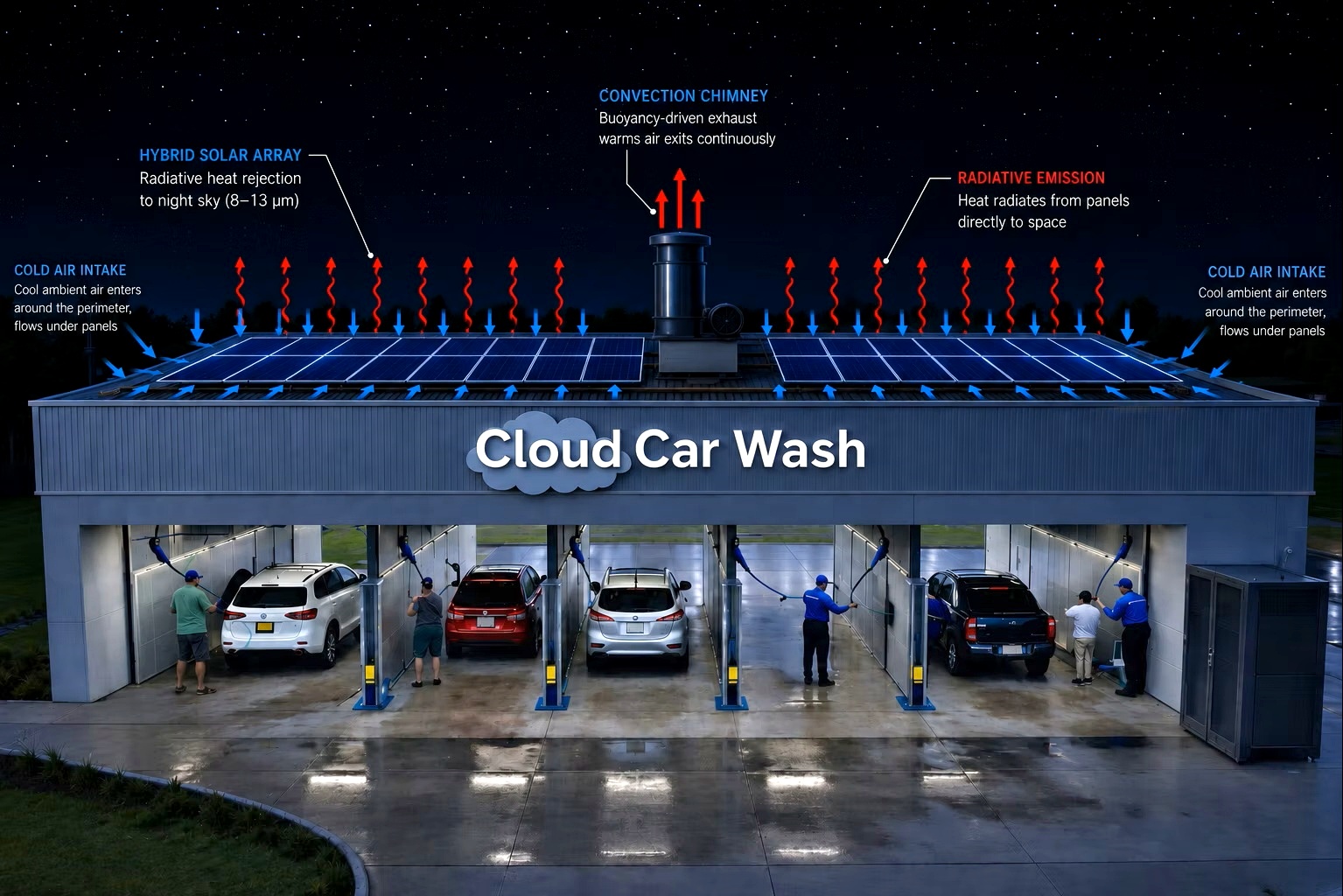
Fanless night cooling · model projections
Let the night sky do the cooling. Use recycled greywater only when it actually helps.
Across nine North American climates, the model pairs 58 and 130.5 kW liquid-cooled AI modules with 24-hour laundromats, heat recovery for wash water and dryers, 170 and 340 m² rooftop PVT arrays, and a treated-greywater-fed hybrid cooler. It evaluates 45 °C supply and 60 °C return water. Fan-free nights are predicted under a quiet-hours 22:00–07:00 dispatch and depend on host demand, roof fit and panel performance; daytime cooling equipment can still make noise.
Source: nine-climate PVT/greywater research manuscript. PVT enhancements have not been field-validated, and the acoustic screening omits pump and tonal noise. A water-management plan and site-specific approvals are prerequisites to deployment. A conventional dry cooler uses no cooling water and may use less electricity in some cases.
93%of captured 58 kW module heat served wash-water and dryer heat in the 24-hour laundromat case.
45%of captured 130.5 kW module heat served the same host in the corresponding case.
599–1,347 m³/yrof municipal water avoided in Los Angeles compared with an evaporative tower serving the whole module.
17 of 18site–module cases had zero cooler-fan hours during quiet hours at the measured-performance anchor.
The business model combines distributed computing, useful heat recovery, water efficiency, real-world service revenue and scalable site economics.
What makes the model different?
It pairs edge compute with facilities that already benefit from heat, hot-water demand, real estate, parking, utilities and local customer traffic.
Why micro data centers?
Shorter physical distance supports lower latency, while distributed siting helps with redundancy, continuity and flexible deployment across many jurisdictions.
Layered economics
Parent-company royalties, franchisee cash flow, utility savings, service revenue and site ownership create several complementary income streams.
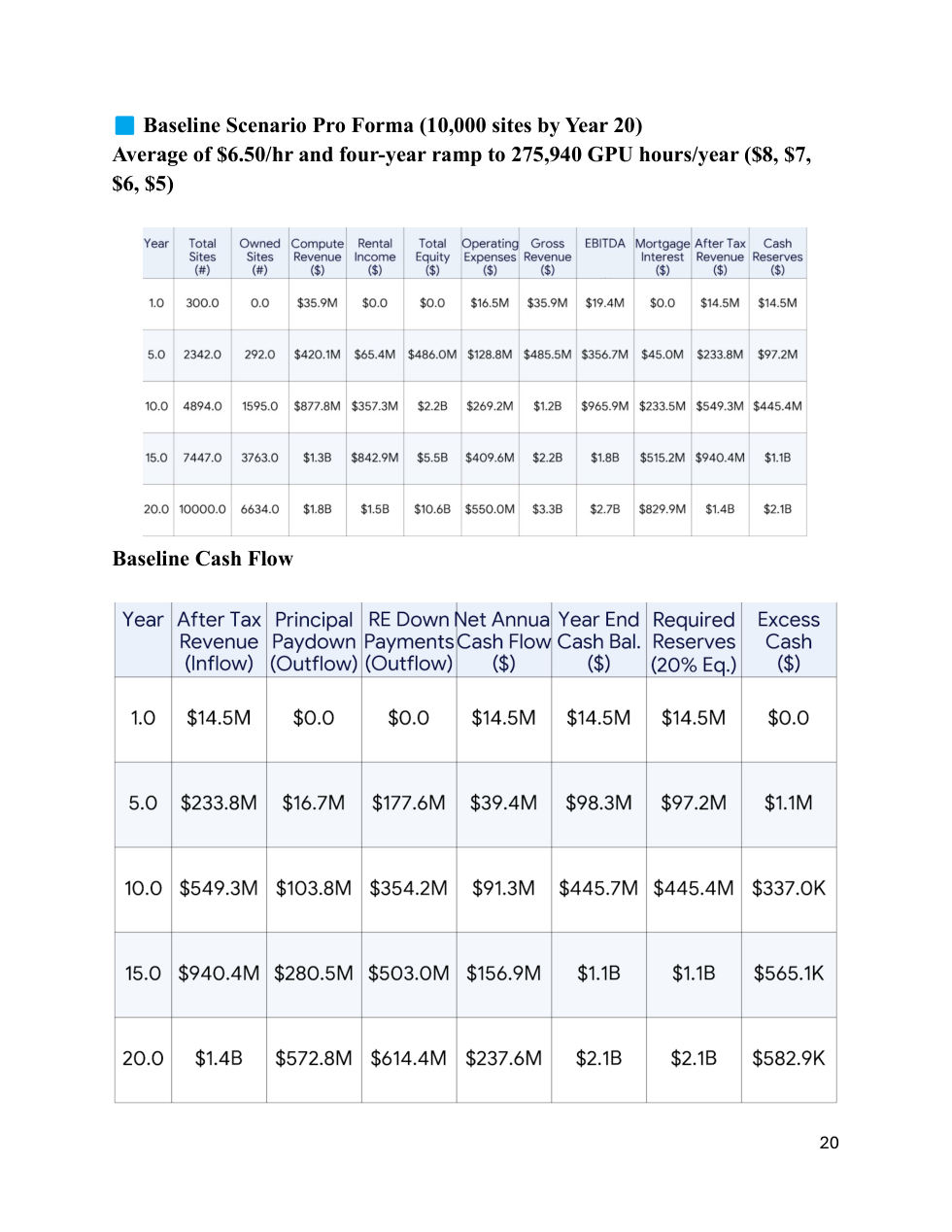
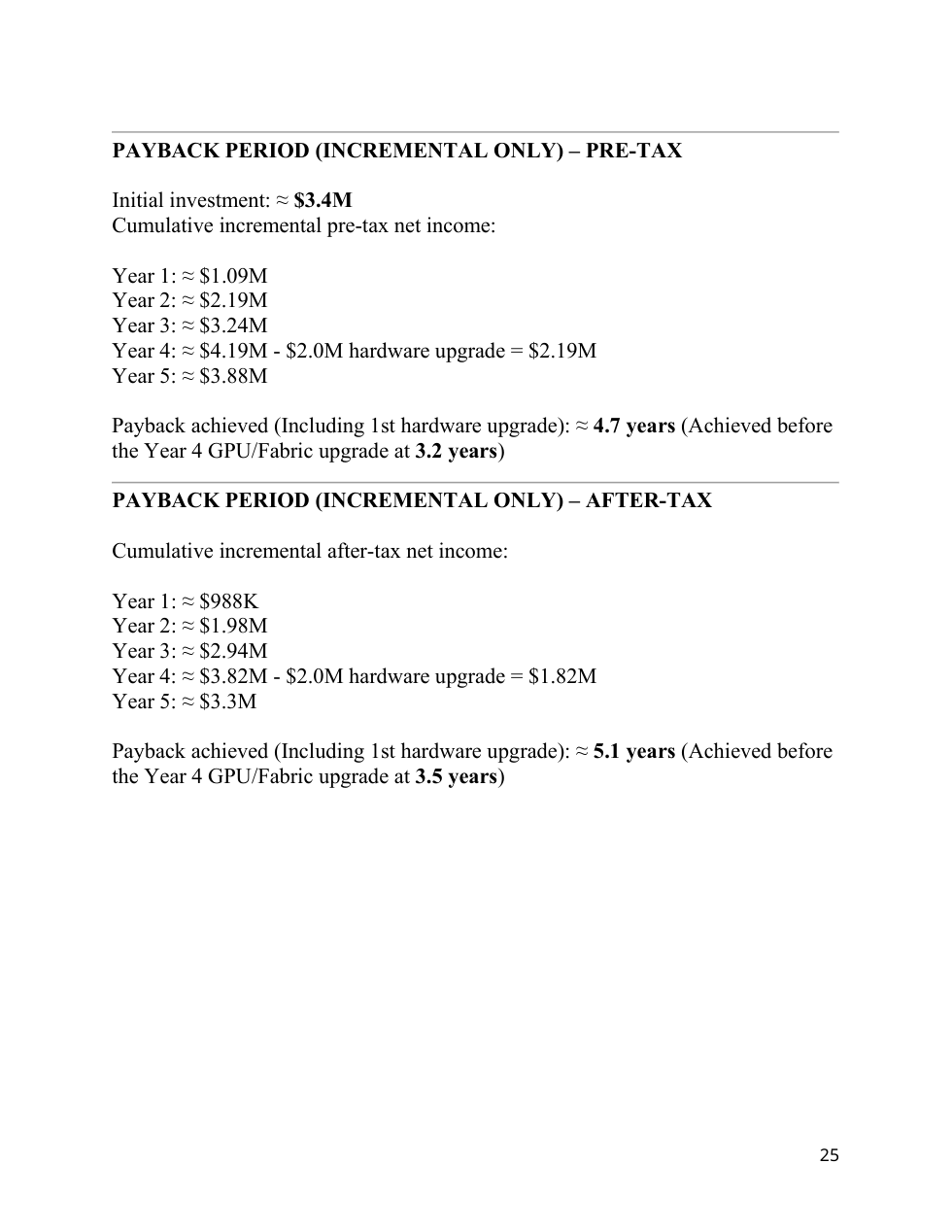
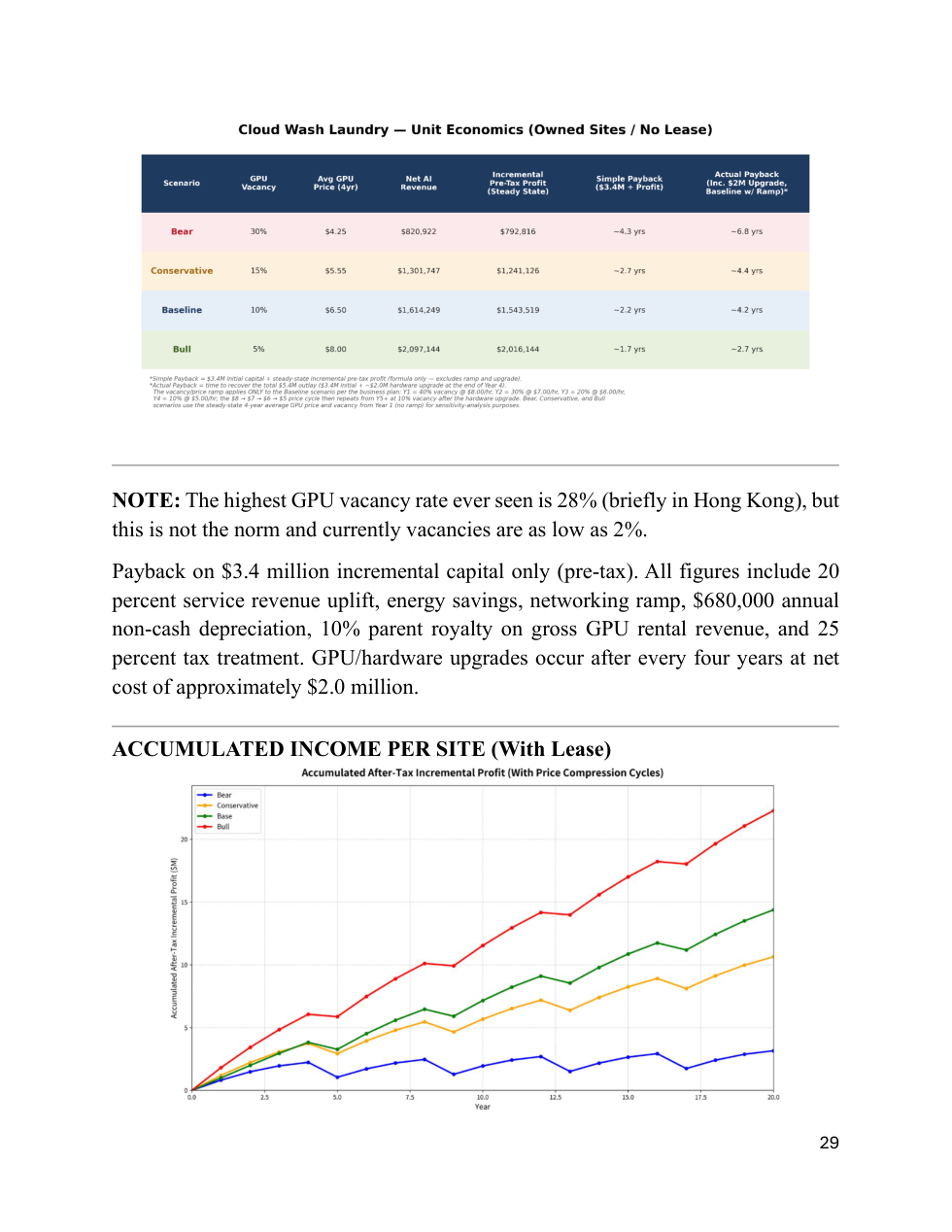
Business Performance Visuals
Selected charts illustrate long-range economics, franchisee payback, environmental performance and enterprise-value scenarios.

The changing public debate
Communities are questioning the water, electricity and financing costs of mega data centers.
Proposals to pause or restrict construction of large AI data centers have gained support among some U.S. lawmakers and state officials, including a 2026 federal moratorium bill and state-level permitting restrictions. Cloud Wash Laundry's response is to explore smaller, heat-sink-matched sites rather than place all computing power into a few very large campuses.


Policy context: H.R. 9442, introduced June 24, 2026; New York's July 2026 hyperscale moratorium. Proposals are not a nationwide enacted ban.
Why conventional data centers face resistance
The public sees the water, power, land and waste-heat problem.
Large centralized data centers can concentrate electricity demand, cooling-water demand, land use and rejected heat in one place. Cloud Wash is designed around the opposite proposition: distribute compute into compatible existing businesses, recover useful heat first, and use water only where it materially improves rejection.
Water
The nine-climate model predicts zero municipal cooling-water withdrawal at each modelled site. Any water evaporated by the hybrid cooling system is supplied from treated laundry greywater; this does not mean there is no consumptive cooling-water use.
Useful heat instead of waste heat
With the specified 24-hour laundromat demand, the 58 kW module supplies 320.9 MWh/year of useful heat (93% of its captured heat), and the 130.5 kW module supplies about 350.3 MWh/year (45%). Actual host loads and compatible temperatures must be measured before deployment.
Existing sites, not giant greenfield campuses
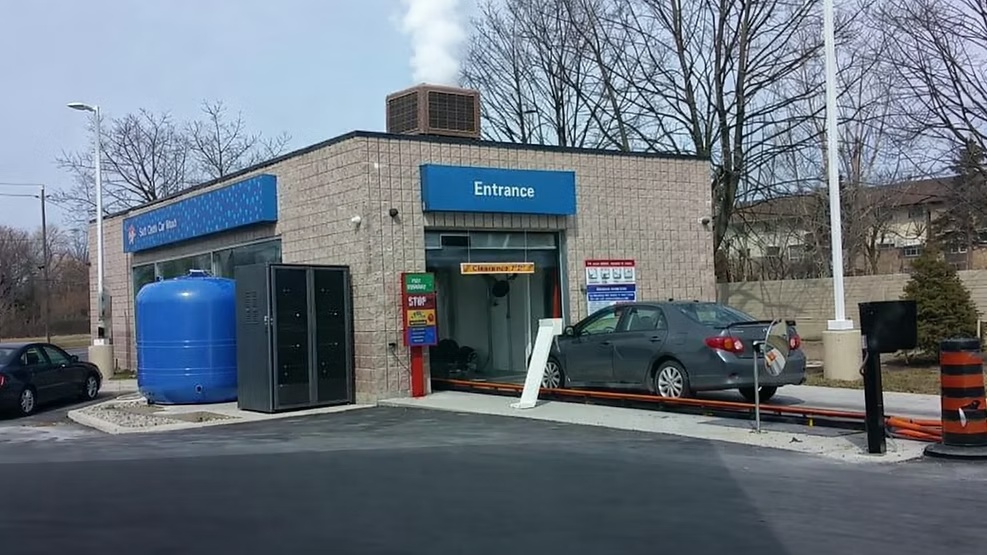
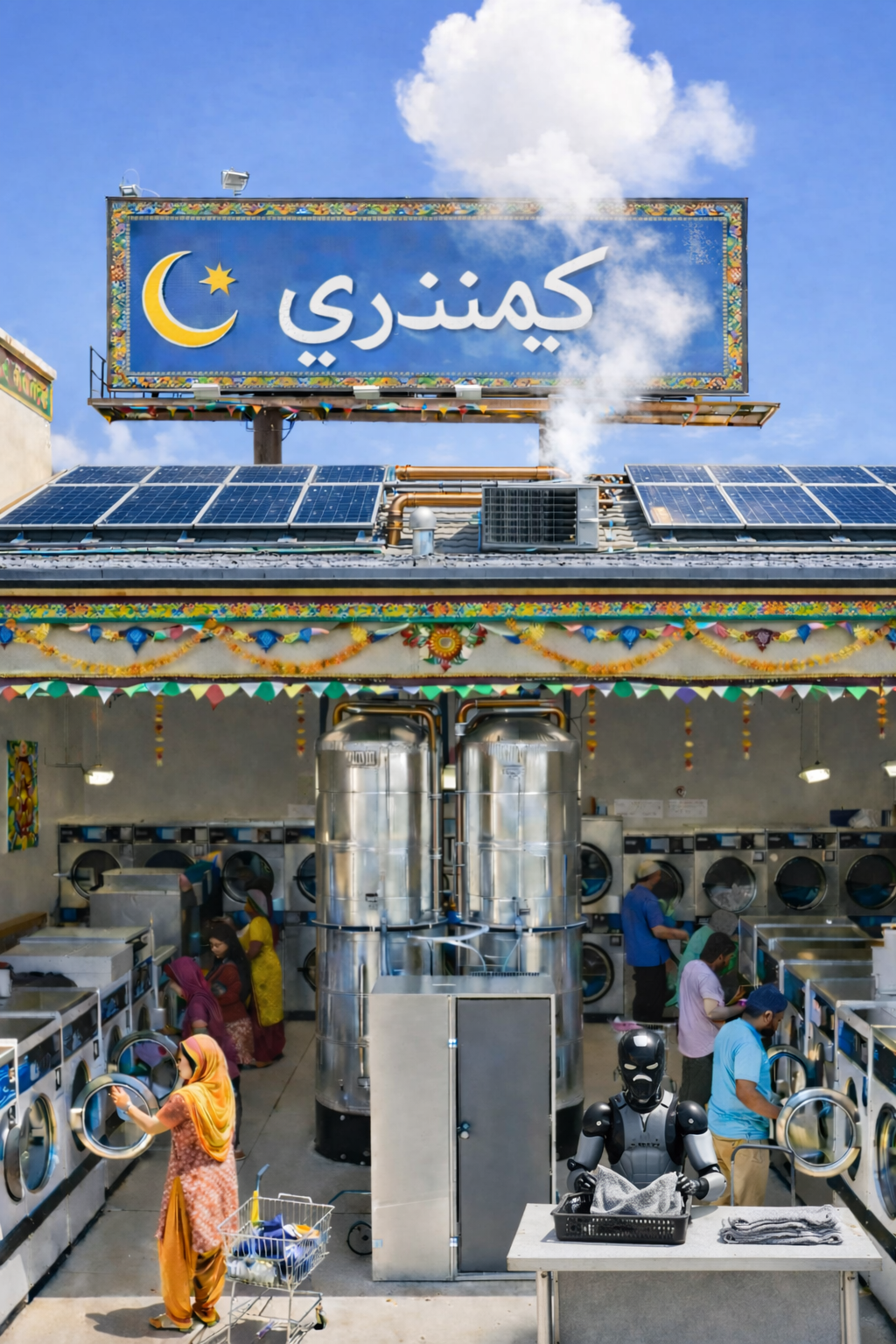
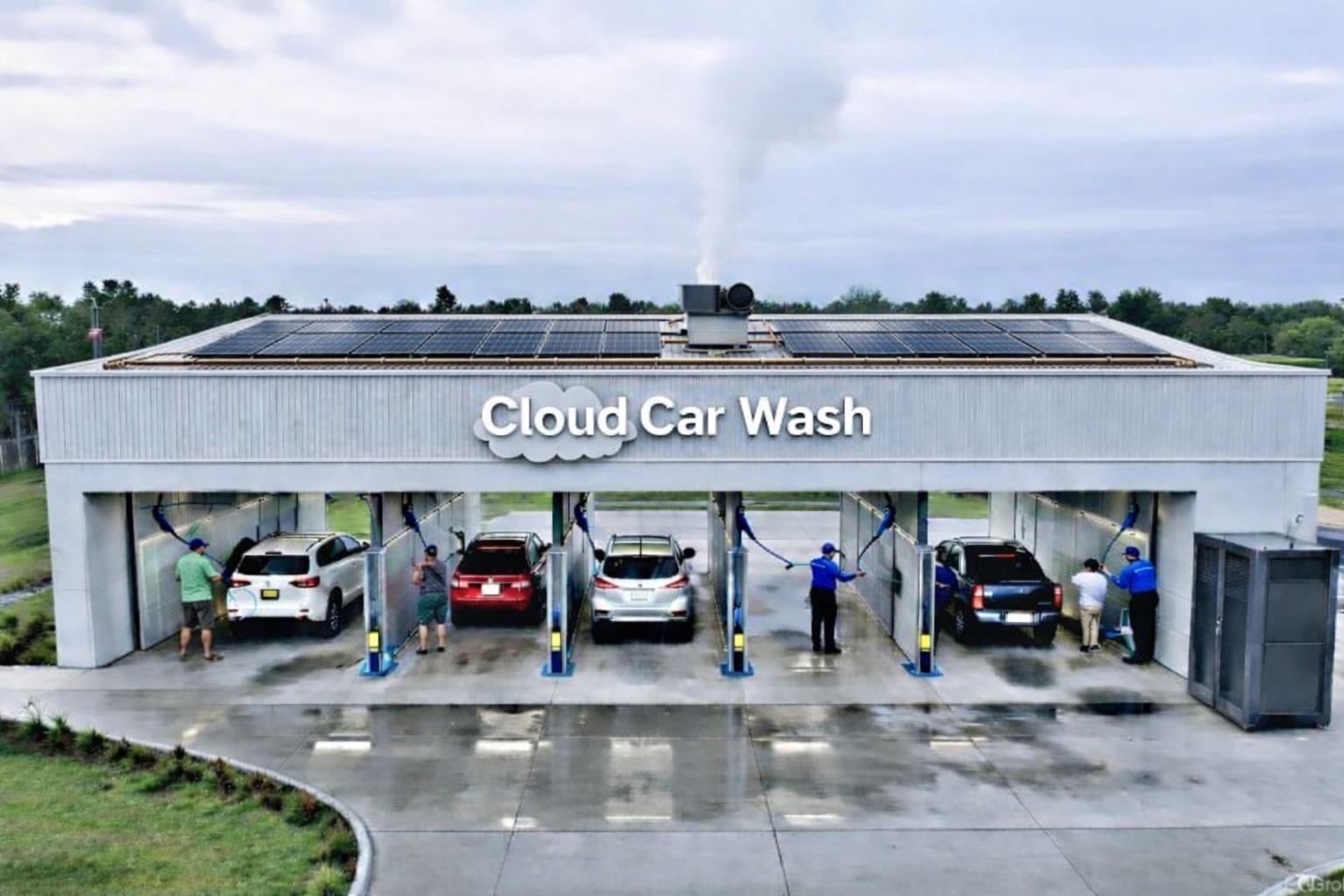
Car washes and laundromats already have recurring thermal demand. The nine-climate model gives a detailed 24-hour laundromat case and treats other host types as sensitivities; a real site still requires a heat-demand audit.
Retrofit targets
Built around businesses that already need water and heat.

Open science downloads
Research manuscript, extended methods and acoustic results.
Fanless photovoltaic–thermal night heat rejection and greywater-fed hybrid cooling for host-sited AI computing
An hourly simulation of 58 and 130.5 kW AI modules at 24-hour laundromats across nine North American climates, with 45 °C coolant supply, 60 °C return, 170 and 340 m² PVT arrays, useful wash-water and dryer heat, and treated-greywater hybrid cooling. Relative to an evaporative tower at equal residual heat-rejection duty, measurement-anchored results show 93–100% less cooling water and 52–59% less cooling electricity. These are simulation results, not measurements of an installed Cloud Wash Laundry system.
Extended results and acoustic analysis
Extended methods report the weather files for nine climates, coil and PVT model sensitivities, annual heat allocation, water use, uncertainty and roof-fit results. The acoustic supplement compares the quiet-hours 22:00–07:00 dispatch with dry coolers and quantifies sound levels and sensitivities at a 10 m receiver. The noise calculations are indicative and do not establish regulatory compliance.